 Padua City Guide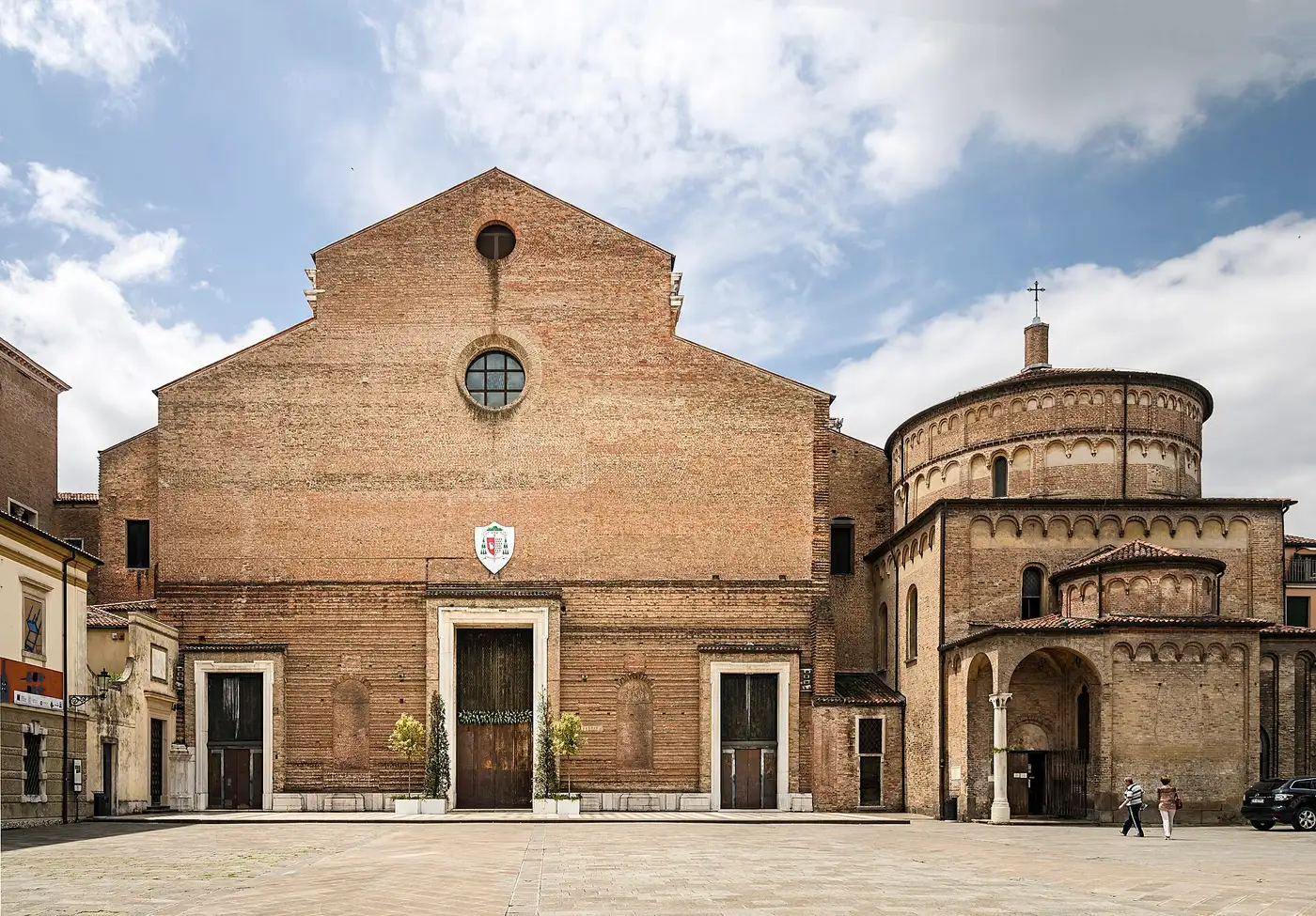
The padua cathedral — the Duomo di Santa Maria Assunta — shares a quiet square behind Piazza dei Signori with one of the finest fresco rooms in Italy: the Baptistery, whose dome, walls and apse Giusto de' Menabuoi covered with a single complete cycle in 1375-1376, culminating in a Paradise of scores of saints radiating around Christ. The pair makes an efficient stop: the cathedral is free and open daily with fixed Mass times, while the Baptistery is visited by ticket in small timed groups with an audio guide, paired with the Bishops' Palace and the Diocesan Museum next door. Since 2021 the Baptistery's cycle belongs to the UNESCO World Heritage listing of Padua's fourteenth-century frescoes, alongside Giotto's Scrovegni Chapel ten minutes east. The current cathedral took shape between the sixteenth and eighteenth centuries on a design associated with Michelangelo, after an earlier church was wrecked by the 1117 earthquake — its unfinished facade is part of its character. Below you will find hours, Masses, ticket prices and the visiting order. The rest of the city is on the Padua City Guide homepage.
Quick answer Free cathedral hours, Baptistery tickets and what the frescoes show
Checked on 12 September 2026: the cathedral is free, open Monday-Saturday 07:00-19:00 and Sunday 08:00-21:00, with sightseeing paused during Mass (weekdays 07:30, 11:00, 18:30). The Baptistery opens by fixed 30-minute audioguide slots, Monday from 14:00, Tuesday-Sunday from 10:00; the combined ticket with the Bishops' Palace and Diocesan Museum is €15.00 (€12.00 reduced, €10.00 residents) and is free with the Padova Urbs Picta Card. Inside the Baptistery, Giusto de' Menabuoi's 1375-1376 cycle runs from Genesis to Apocalypse and ends at the Paradise dome. Budget 45 minutes for the Baptistery and 45 for the museum, then cross to Piazza dei Signori and Piazza delle Erbe for the market squares.
Key takeaways
- Cathedral free, daily: 07:00-19:00 (Mon-Sat), 08:00-21:00 (Sunday).
- Baptistery by timed slot with audioguide; combo with Diocesan Museum €15.00 full.
- Free with the Padova Urbs Picta Card — the UNESCO fresco-cycle ticket.
- Menabuoi's cycle dates to 1375-1376 and covers the walls and dome completely.
- The cathedral's facade was left unfinished — the 1551 design is associated with Michelangelo.
Key facts
Opening hours
| Cathedral, Monday-Saturday | 07:00–19:00 |
|---|---|
| Cathedral, Sunday and solemnities | 08:00–21:00 |
| Baptistery visits, Monday (fixed slots) | 14:00–18:00 |
| Baptistery visits, Tuesday-Sunday (fixed slots) | 10:00–18:00 |
Closed Cathedral open daily (sightseeing paused during Mass); Baptistery closed 25 December and for liturgical events; Diocesan Museum morning hours end at 13:00
Admission
- Adult
- Cathedral free; Baptistery + Bishops' Palace + Diocesan Museum combined ticket €15.00
- Reduced
- Baptistery combo €12.00 (up to 25, Touring Club, MUSME ticket holders); €10.00 residents of Padua and the diocese; family rates €12.00 adult / €10.00 under-18
- Free
- Cathedral always free; Baptistery free with the Padova Urbs Picta Card; children 0-6, visitors with disabilities and carers free
Planning it
- Time needed
- Cathedral 20-30 min; Baptistery audioguide visit 45 min + Diocesan Museum 45 min
- Book ahead
- Optional — walk-up usually fine
- Address
- Piazza Duomo, 35139 Padova (Baptistery and Diocesan Museum ticket office at Piazza Duomo 12)
A cathedral rebuilt after the 1117 earthquake
A cathedral has stood on Piazza Duomo since the fourth century, and the building consecrated in 1075 was wrecked so badly by the earthquake of 1117 that rebuilding never really stopped. The church you enter today is the result of the great early-modern campaign: from the sixteenth century onward, the architects Andrea da Valle and Agostino Righetti carried out a project drawn up in 1551 on a design associated with Michelangelo himself, though with substantial changes. Work dragged on for more than two centuries and finished only in 1754 under the Venetian architect Girolamo Frigimelica — and the facade was left incomplete, with its three portals and two rose windows later scarred again by the bombardments of 1917-1918. That raw, unfinished west front is why many visitors walk past without realising what is inside.
Inside, the mood changes: a tall three-aisled Latin-cross nave, bright and severe, leading to the presbiterio installed in 1997 with polychrome sculptures by Giuliano Vangi — angels carrying the altar, the patron saints Prosdocimus and Justina, Anthony and Gregory Barbarigo, and a six-metre crucifix in special alloys that seems to float over the sanctuary. Descend to the crypt to see the urn of Saint Daniel, Padua's fourth-century bishop, under an altar with bronze reliefs by Tiziano Aspetti, and the chapel where the bishops of Padua are buried.
- 1075: the Romanesque cathedral is consecrated by Bishop Ulderico.
- 1117: the great earthquake heavily damages the building.
- 1551: a design associated with Michelangelo is adopted; Andrea da Valle and Agostino Righetti execute it with changes.
- 1754: the interior campaign concludes under Girolamo Frigimelica; the facade remains unfinished.
- 1997: the new presbiterio with sculptures by Giuliano Vangi is inaugurated.
Giusto de' Menabuoi's complete fresco cycle in the Baptistery
The round Baptistery beside the cathedral, rebuilt in its present form in the thirteenth century, was frescoed from floor to dome by Giusto de' Menabuoi between 1375 and 1376 (with a few scenes completed by 1378) at the command of Fina Buzzaccarini, wife of the lord of Padua Francesco il Vecchio da Carrara, whose burial chapel it became. Nothing here is fragmentary: the cycle reads continuously from the Old Testament narrative on the walls, through the life of Christ and the Virgin, up into the dome, where Christ enthroned anchors a Paradise of saints arranged in concentric rings — a complete statement of medieval theology rendered in fresco. The effect, in a small dark room you have almost to yourself, is closer to the Scrovegni Chapel than to any parish church.
How the audioguide visit works
Admission is organised, not free-roaming. Your combined ticket covers a 45-minute Baptistery visit with an audioguide (Italian, English, French, German, Spanish) plus 45 minutes in the Bishops' Palace and Diocesan Museum — the two halves can be taken in either order, even on different days. Slots run every 30 minutes: Monday from 14:00 to 17:30, Tuesday to Thursday 10:00-17:30, Friday to Sunday 10:00-17:30 with a midday reshuffle.
The ticket office sits at Piazza Duomo 12; arrive fifteen minutes early. A guided Italian tour of Baptistery, palace and museum runs on Fridays, weekends and holidays at 10:45 and 14:45 (suspended in July and August) for €18.00 full price.
Mass times and visiting etiquette
The cathedral is a working parish: Masses run at 07:30, 11:00 and 18:30 on weekdays (morning praises at 08:00), 07:30 and 16:30 on Saturdays, and 09:30, 11:30, 18:30 and 20:00 on Sundays and holy days, with vespers at 17:00 on Sundays. Tourist visiting pauses during services. Shoulders and knees covered is enforced as in any Italian cathedral, keep voices low, and skip flash photography.
Confession times are posted by the door.
The Urbs Picta Card and pairing with the Scrovegni
The Baptistery is one of the eight monuments of the Padova Urbs Picta UNESCO listing (2021), and the combined UNESCO-site ticket — the Urbs Picta Card — includes the Baptistery visit free. If you are booking the Scrovegni Chapel anyway, check whether the card beats buying separately; the chapel itself needs a reserved timed slot weeks or months ahead in season. A sensible same-day order: Baptistery slot at 10:00, cathedral at 11:00, lunch near the squares, Scrovegni slot in the afternoon.
| Site | Entry | Hours | Time needed |
|---|---|---|---|
| Cathedral (Duomo) | Free | Mon-Sat 07:00-19:00; Sun 08:00-21:00 | 20-30 min |
| Baptistery | Combo ticket €15.00 / reduced €12.00 / residents €10.00; free with Urbs Picta Card | Fixed slots Mon 14:00-17:30; Tue-Sun 10:00-17:30 | 45 min |
| Bishops' Palace + Diocesan Museum | Included in the same combo (or €8.00 alone) | Mon 14:00-18:00; Tue-Sun 10:00-13:00 & 14:00-18:00 | 45 min |
| Crypt and presbiterio | Included in cathedral visit | Cathedral hours | 10 min |
Prices and formats as published by the Diocesan Museum of Padua (museodiocesanopadova.it) and the cathedral parish (cattedralepadova.it), checked on 12 September 2026. The Baptistery is not sold as a stand-alone ticket — the audioguide visit is bundled with the Bishops' Palace and Diocesan Museum.
Take the €15.00 combined audioguide ticket unless you already hold the Urbs Picta Card, in which case the Baptistery is free.
| Option | What it covers | Price | Where | Book |
|---|---|---|---|---|
| Cathedral entryEveryone | Nave, Vangi presbiterio, crypt — outside Mass times | Free | Parish site | Official site |
| Baptistery + Bishops' Palace + Diocesan MuseumEveryone | 45-min audioguide visit (it/en/fr/de/es) + museum | €15.00 full / €12.00 reduced / €10.00 residents | Diocesan Museum info | Official site |
| Guided Italian tourItalian speakers | Baptistery + palace + museum, Fri-Sun and holidays at 10:45 & 14:45 (not Jul-Aug) | €18.00 full / €15.00 reduced | Diocesan Museum info | Official site |
| Guided city walk through the cathedral quarterFirst-day visitors | See tour card for departures | See tour card | Check Availability | Check Availability |
| UNESCO frescoes-themed walk incl. the Baptistery exteriorFresco-focused travellers | See tour card | See tour card | Check Availability | Check Availability |
Padua's UNESCO fresco sites compared
Padua's 2021 UNESCO serial listing gathers the city's fourteenth-century fresco complexes; the figures below come from the operators' own pages and were checked on 12 September 2026, with the Scrovegni Chapel linked to its dedicated ticket page because its slot system changes by season.
| UNESCO site | Frescoes | Visit format | Entry |
|---|---|---|---|
| Baptistery of the Duomo | Giusto de' Menabuoi, 1375-1376 | 45-min audioguide slot + Diocesan Museum | €15.00 combo; free with Urbs Picta Card |
| Scrovegni Chapel | Giotto, 1303-1305 | 15-minute timed slot, reservation mandatory | Paid timed ticket — see Scrovegni Chapel tickets |
| Palazzo della Ragione | Fifteenth-century astrological cycle by Nicola Miretto and shop | Self-guided civic monument between the market squares | Civic ticket — check tickets |
| Oratorio di San Giorgio & Scuola del Santo | Altichiero and the young Mantegna, beside the Basilica of Saint Anthony | Small chapels near the basilica complex | Modest admission — confirm on site |
Piazza Duomo: the unfinished cathedral facade of 1551-1754 and, beside it, the round Baptistery.
Cathedral and Baptistery on the map
The cathedral quarter sits behind the two market squares, an easy link on any old-town circuit. Pins mark the church, the ticket office and the surrounding stops.
Guided tours that include the cathedral quarter
The Baptistery's own audioguide handles the frescoes; these catalogue walks add the quarter, its squares and the stories behind them.
 from $69.61
Padua: Experience Padova Like a Local – Guided Tour
The local-life pick: squares, alleys, and a tasting at Pedrocchi or the market
Check Availability from $61.49
Prices, ratings and details are the platform's own, checked in Q3 2026; dollar figures are the listed prices — the platform bills in your account's currency.
Frequently asked questions about the Duomo and Baptistery
Is the Baptistery part of the cathedral building?
No — it is a separate round building on the same square, as in most Italian cathedral cities. Entry is through the ticket office at Piazza Duomo 12, not through the church, and it uses its own timed-slot system.
How much does the battistero padova cost in 2026?
The combined ticket (45-minute audioguide visit to the Baptistery plus the Bishops' Palace and Diocesan Museum) costs €15.00 full, €12.00 reduced (up to 25, Touring Club, MUSME ticket holders), €10.00 for residents of Padua and the diocese, with family rates at €12.00 per adult and €10.00 per under-18. Children 0-6 and visitors with disabilities enter free, and the Padova Urbs Picta Card includes the visit at no extra charge.
When can I attend Mass at the cathedral?
Weekdays at 07:30, 11:00 and 18:30 (morning praises at 08:00); Saturdays at 07:30 and 16:30; Sundays and holy days at 09:30, 11:30, 18:30 and 20:00, with vespers at 17:00. Tourist visits pause during services, so plan sightseeing around them.
Why is the cathedral facade unfinished?
The 1551 project associated with Michelangelo was carried out with modifications by Andrea da Valle and Agostino Righetti, but the campaign did not finish until 1754 and the facade was never completed. Bombardments in 1917-1918 then damaged the portals and rose windows that do exist.
What does the Baptistery dome depict?
The Paradise: Christ enthroned at the centre with scores of saints arranged in concentric rings around him, part of a single continuous cycle from the book of Genesis through the life of Christ to the Apocalypse, painted by Giusto de' Menabuoi in 1375-1376 for Fina Buzzaccarini.
Is there a dress code?
Yes. Shoulders and knees covered, as in all Italian churches — this is enforced in both the cathedral and the Baptistery. In summer carry a light scarf or shirt; guards do turn visitors away.
How much time should I plan for the whole square?
Twenty to thirty minutes for the cathedral including the crypt, forty-five for the Baptistery audioguide visit and forty-five for the Diocesan Museum — call it two hours if you do everything, or about seventy minutes for cathedral plus Baptistery only.
What to visit near the Duomo and Baptistery
The cathedral quarter connects directly into the market squares and the university district:
Piazza dei Signori
The astronomical clock tower and loggia square, two minutes east.
Piazza delle Erbe
The daily market under Palazzo della Ragione, three minutes east.
Scrovegni Chapel
Giotto's cycle in the other great fresco room, ten minutes east — reserve ahead.
Caffè Pedrocchi
The 1831 historic cafe, five minutes south.
University of Padua
Palazzo Bo and the anatomical theatre, five minutes on foot.
Reviewed Q3 2026 (July–September 2026); next review Q4 2026. Prices, hours and terms are set by the venue or operator and confirmed at checkout.
We may earn a commission if you book through one of our links, at no extra cost to you. Full affiliate disclosure