 Padua City Guide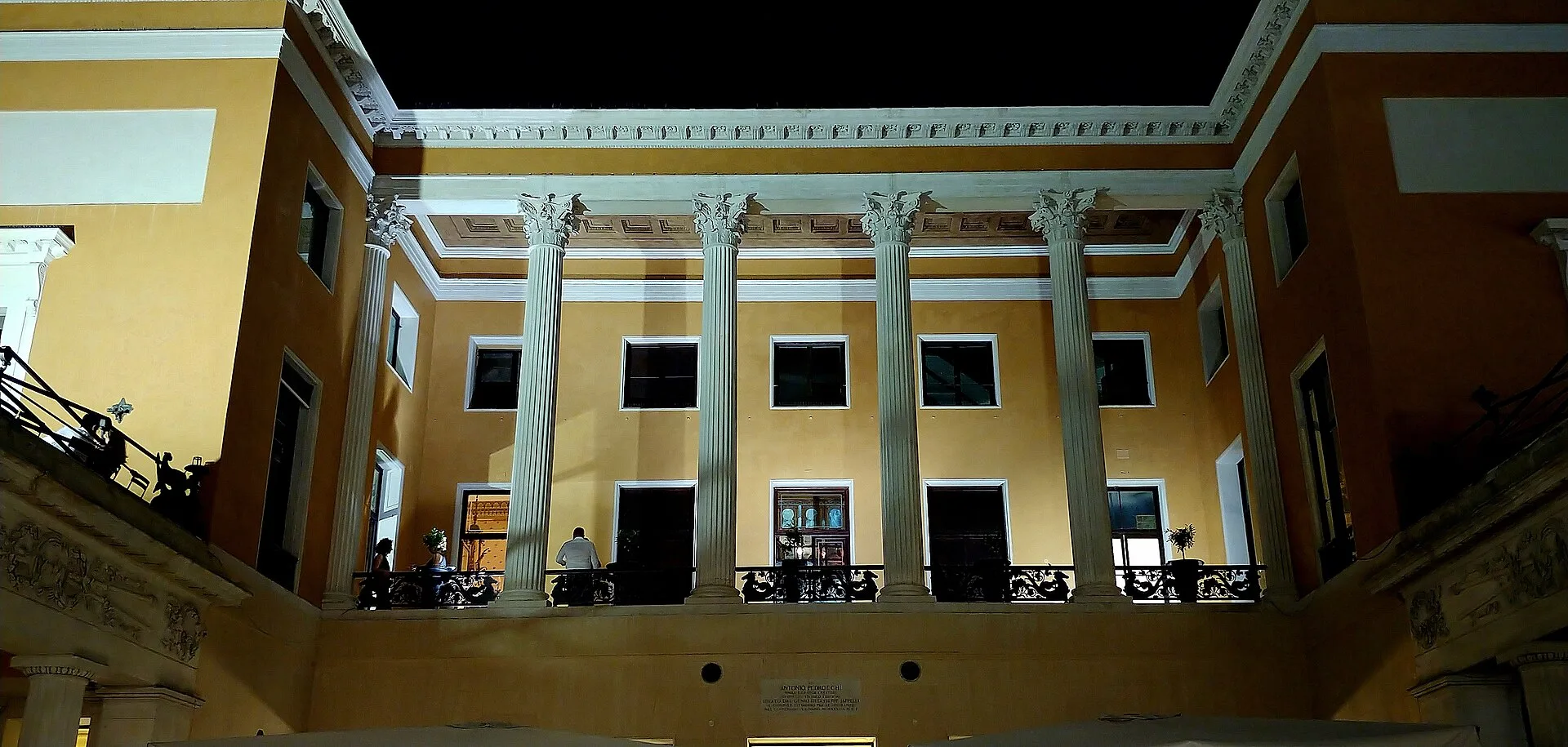
The caffè Pedrocchi has stood between Via VIII Febbraio and Piazza dei Signori since 1831, and for most of that time it has been the living room of Padua. Designed by the architect Giuseppe Jappelli, it was known for a century as the café without doors because it never closed them: from opening day until 1916 the establishment ran around the clock, serving professors, students, writers and Risorgimento conspirators at any hour. That tradition of open access survives in a practical way today — you can walk into the ground-floor historic halls for free, seven days a week, and pay only for what you drink. The green-and-white neoclassical building, with the octagonal Pedrocchino wing at its corner, sits two minutes from Piazza dei Signori and five from Piazza delle Erbe, which makes it the natural coffee stop in any old-town itinerary. This page covers the history, the rooms, the famous mint-cream coffee, and the museum upstairs. For everything else the city offers, start from the Padua City Guide homepage.
Quick answer Opening hours, entry, the historic rooms and the famous coffee
Checked on 12 September 2026: Caffè Pedrocchi is open every day from 08:00 to midnight, and entry to the ground-floor historic rooms is free — you only pay for what you order. Order a caffè Pedrocchi, the house speciality: espresso crowned with mint cream that you neither sugar nor stir. Upstairs, the Museo del Risorgimento e dell'Età Contemporanea occupies the Piano Nobile (Tue-Sun 09:30-12:30 and 15:30-18:00, €5.00, closed Mondays). Pair the stop with the arcades of Piazza dei Signori and an evening cicchetto crawl from cichetti and bacari.
Key takeaways
- Free entry: the ground-floor historic halls are open to everyone daily 08:00-24:00.
- The signature drink: caffè Pedrocchi, espresso with mint cream — never sugared or stirred.
- Opened 1831, designed by Giuseppe Jappelli; the Pedrocchino wing followed in 1837-1842.
- Called the cafe without doors: it ran around the clock from 1831 until 1916.
- Risorgimento museum on the Piano Nobile: Tue-Sun mornings and late afternoons, €5.00.
Key facts
Opening hours
| Caffetteria and historic rooms (daily) | 08:00–24:00 |
|---|---|
| Museo del Risorgimento, Piano Nobile (Tue-Sun) | 09:30–18:00 |
Closed Cafe open all year; museum closed Mondays (except public holidays), 1 May, 25-26 December, 1 January; museum closes 12:30-15:30
Admission
- Adult
- Free entry to the ground-floor historic rooms; Risorgimento museum €5.00
- Reduced
- Museum €4.00 reduced; €3.00 young people and students
- Free
- Ground-floor halls and counters free (you pay only what you consume)
Planning it
- Time needed
- 30 to 60 minutes
- Book ahead
- Optional — walk-up usually fine
- Address
- Via VIII Febbraio 15, 35122 Padova (museum entrance: piazzetta Cappellato Pedrocchi)
A cafe without doors: the history from 1831 to today
Caffè Pedrocchi opened on 9 June 1831, funded by the bequest of the Genoese-born merchant Francesco Pedrocchi and completed by his son Antonio, who commissioned the young architect Giuseppe Jappelli. The building that resulted was deliberately civic rather than domestic: a long ground floor of halls and counters under a sober neoclassical facade, with reading rooms where newspapers from across Europe could be consulted for the price of a coffee. In an age when cafes were the engines of political debate, Padua's version became the meeting point for the students of one of Europe's oldest universities and for the patriots who organised the Risorgimento in the Veneto.
The nickname that stuck, il caffè senza porte — the cafe without doors — describes its operating model rather than its architecture: from 1831 until 1916 the establishment never shut, serving coffee through the night to students finishing dissertations, travellers arriving on night trains, and revolutionaries who preferred not to be seen at dawn. Doors were finally fitted during the First World War, after wartime air raids damaged the building. The Pedrocchino, the small octagonal wing added between 1837 and 1842 at the corner of Via VIII Febbraio, gave the cafe the sculpted, lighter counterpoint to Jappelli's austere main block that you still photograph today. Stendhal and Gabriele d'Annunzio number among the guests who wrote about it, and generations of Paduan graduates have celebrated their degrees here.
- 1831: the cafe opens on 9 June to Giuseppe Jappelli's design.
- 1837-1842: the octagonal Pedrocchino wing is added on Via VIII Febbraio.
- 1831-1916: the cafe runs around the clock — the 'cafe without doors' era.
- 1916: doors are installed after First World War air-raid damage.
- 20th century: the upper floor houses the civic Risorgimento museum, today run with Padova Musei.
What to see inside: the historic halls and the Piano Nobile
Walking into the ground floor costs nothing, and the sequence of halls is the real sight. Start at the main counter on Via VIII Febbraio, then move through the Sala Verde, the Sala Bianca and the Sala Rossa — each kept in its nineteenth-century decor — and finish in the octagonal Sala Ottogonale of the Pedrocchino wing, where Jappelli's stucco and mirrors give the room a theatrical depth that photographs well at any hour. Service is at the counter for a quick espresso or at the tables for anything longer; aperitivo time, from roughly 18:00, is when the halls fill and the pasticceria counter does most of its business.
The first floor is a separate, ticketed visit. The Piano Nobile houses the Museo del Risorgimento e dell'Età Contemporanea (MUREC), part of the city's civic museum network, with documents, uniforms and memorabilia covering the Risorgimento, the two world wars and twentieth-century Padua. The entrance is not the cafe's main door but the piazzetta Cappellato Pedrocchi on the flank of the building; a lift for visitors with reduced mobility is reached from vicolo Cappellato Pedrocchi by calling the museum desk. Give the museum forty-five minutes if you read the panels, twenty if you only want the rooms themselves.
The halls directory
Use this quick map of the rooms before you step in, so you know which doors you can simply walk through and which visits need a ticket or a booking.
| Space | Where | Access | What to look for |
|---|---|---|---|
| Main cafe counter | Via VIII Febbraio 15 | Free, daily 08:00-24:00 | The marble counters and the espresso machines; order the caffè Pedrocchi here |
| Sala Verde, Sala Bianca, Sala Rossa | Ground floor, behind the counter | Free walk-in | Nineteenth-century decor, mirrors and stucco kept from the historic fit-out |
| Sala Ottogonale (Pedrocchino) | Octagonal wing, corner of Via VIII Febbraio | Free walk-in | Jappelli's octagonal room with the 1837-1842 stucco decoration |
| Museo del Risorgimento (MUREC) | Piano Nobile, entrance piazzetta Cappellato Pedrocchi | Ticketed, Tue-Sun 09:30-12:30 & 15:30-18:00 | Risorgimento and 20th-century Padua: documents, uniforms, memorabilia |
| Restaurant and pasticceria | Upper ground level and side halls | Walk-in or reservation | Venetian cooking at lunch and dinner; Torta Pedrocchi at the pastry counter |
The mint-cream rule
The house coffee is an espresso topped with a dollop of mint cream. The ritual is fixed and the staff will tell you if you get it wrong: never sugar it, never stir it. The cold cream over the hot espresso is the point.
If mint is not your thing, the classic alternatives are a caffe latte or a hot chocolate from the pasticceria, and the Torta Pedrocchi — a chocolate-and-mint cake in the same flavour family as the signature drink — is the standard souvenir purchase.
Entry options at Caffè Pedrocchi, using the hours and tariffs published by the cafe (caffepedrocchi.it) and Padova Musei (padovamusei.it) and checked on 12 September 2026. Nothing on this page needs advance booking — the tour rows are optional guided walks that pass the cafe.
Walk in for free and order at the counter; buy the museum ticket only if twentieth-century history interests you.
| Option | Access and hours | Price | Booking | Book |
|---|---|---|---|---|
| Historic ground-floor roomsEveryone | Walk-in, daily 08:00-24:00 | Free (pay for what you consume) | Official cafe site | Official site |
| Museo del Risorgimento (Piano Nobile)History readers | Tue-Sun 09:30-12:30 & 15:30-18:00; closed Mondays (except holidays) | €5.00 full / €4.00 reduced / €3.00 young & students | Padova Musei hours and tickets | Official site |
| Padua old-town walking tourFirst-time visitors | Fixed daily departures, ~2 hours | See tour card | Check Availability | Check Availability |
| Guided aperitivo and cichetti walk past Piazza dei SignoriFood-leaning visitors | Evening departures | See tour card | Check Availability | Check Availability |
Where to drink in the centre: Pedrocchi compared
Figures are qualitative because none of these stops publishes a fixed cover charge; the format differences below come from the operators' own pages and were checked on 12 September 2026. Use them to decide between a seated historic stop and the standing-counter circuit.
| Stop | Format | What it costs | Best time |
|---|---|---|---|
| Caffè Pedrocchi | Seated table service in 19th-century halls, counter service at the bar | Free entry; coffee and pastries at historic-cafe prices, menus posted at the door | Morning coffee or the 18:00-20:30 aperitivo |
| Bacari near Piazza delle Erbe | Standing counter, cichetti eaten on the street | Small fixed prices per cicchetto and glass — see cichetti and bacari | Evening, 18:30-21:30 |
| Terrace cafes on Piazza dei Signori | Outdoor tables on the square | Menu prices plus table service, highest in the centre after dark | Late evening in the warm months |
The neoclassical facade of Caffè Pedrocchi on Via VIII Febbraio, unchanged in outline since Jappelli's 1831 building.
Caffè Pedrocchi on the map
The cafe sits at the hinge between the shopping streets and the medieval squares, so almost every central walk passes its door. The pins below mark the cafe itself and the sights within a ten-minute radius.
Guided tours that include the Pedrocchi area
The cafe needs no guide, but pairing it with a guided walk gives you the Risorgimento context the rooms hint at. These departures are checked against our tour catalogue on the date shown.
 from $69.61
Padua: Small-group walking tour with the Scrovegni Chapel
Best value: the slot and the fresco context in one booking
Check Availability from $61.49
Prices, ratings and details are the platform's own, checked in Q3 2026; dollar figures are the listed prices — the platform bills in your account's currency.
Frequently asked questions about Caffè Pedrocchi
Is there an entry fee for the historic rooms of the caffè Pedrocchi?
No. The ground-floor halls and counters are free to enter during opening hours, daily 08:00-24:00; you pay only for what you order. The only ticketed space is the Risorgimento museum on the Piano Nobile (€5.00 full price).
Why was Caffè Pedrocchi called the cafe without doors?
Because between 1831 and 1916 it never closed: staff served coffee around the clock, and doors were only fitted after First World War air-raid damage made round-the-clock opening impractical. Paduans still use the nickname il caffè senza porte.
What exactly is a caffè Pedrocchi?
The house speciality: an espresso served under a cap of sweet mint cream. The rule is that you do not sugar it and you do not stir it — the cold mint cream against the hot espresso is the design. It is also the base of the chocolate-and-mint Torta Pedrocchi sold at the pastry counter.
Is the Piano Nobile open to visitors, and how much does it cost?
Yes. The Museo del Risorgimento e dell'Età Contemporanea occupies the first floor and is open Tuesday-Sunday 09:30-12:30 and 15:30-18:00 (closed Mondays except public holidays, plus 1 May, 25-26 December and 1 January). Admission is €5.00, with €4.00 and €3.00 reductions. The entrance is on piazzetta Cappellato Pedrocchi, not the cafe's main door.
How far is Caffè Pedrocchi from the Scrovegni Chapel?
About ten minutes on foot. Walk north from Via VIII Febbraio, cross Via Roma and continue up Via Filippo Corridi to the Eremitani museums complex, where the chapel entrance sits beside the archaeological museum. Reserve the chapel slot in advance — see Scrovegni Chapel tickets.
Do I need to book a table at Caffè Pedrocchi?
Not for coffee or pastries — walk in. Reservations are expected for the restaurant at lunch and dinner and for events in the upper halls; the cafe publishes contact numbers on its own site. At aperitivo time (roughly 18:00-20:30) expect a short wait for the best tables.
Is the Pedrocchi open on Sundays and public holidays?
Yes. The cafe and its historic ground-floor rooms open daily 08:00-24:00, including Sundays and most holidays. The only schedule exception is the upstairs museum, which closes on Mondays that are not public holidays.
What to visit near Caffè Pedrocchi
The cafe anchors the densest sightseeing block in Padua. These five stops are all within a fifteen-minute walk:
Piazza dei Signori
The clock tower and Renaissance loggia square that starts at the cafe's corner.
Piazza delle Erbe
The daily market square and the densest bacari strip, two minutes east.
University of Padua
Palazzo Bo, with the 1594-1595 anatomical theatre, three minutes on foot.
Duomo and Baptistery
The cathedral square and Giusto de' Menabuoi's frescoed dome, five minutes west.
Cichetti and bacari
How the evening standing-counter ritual works, and which squares to aim for.
Reviewed Q3 2026 (July–September 2026); next review Q4 2026. Prices, hours and terms are set by the venue or operator and confirmed at checkout.
We may earn a commission if you book through one of our links, at no extra cost to you. Full affiliate disclosure